Author: Dean Burgess

  • Grandy and Jones’s Barber Shop

    The thing about Grandy and Jones’s Barber Shop was the way the air changed the minute I walked in. It always hit me first in the nose: a sharpness of witch hazel and talcum, sweetened by pipe smoke, and then the tang of steel when the old men scraped their razors on the leather strop. You could tell it was a man’s place by how every surface was nicked and burnished and a little sticky with history—right down to the checkerboard linoleum, which looked like someone had spilled a hundred years of stories on it and tried to mop them up with spit and a dirty rag.

    I was eight years old, which was too young for some things but not for the world of Grandy and Jones. I’d started coming with Daddy on Saturdays, trailing him like a barncat on a milk run, just to sit and listen. The barbers, Mr. Grandy and Mr. Jones, ran the shop together but argued about everything from baseball teams to the best way to sharpen a razor. Mr. Grandy was slim and neat in his white smock and always drank his Pepsi from a green glass bottle. Mr. Jones was all belly and jowls and a voice that could scare a possum out of a tree, but he had the gentlest hands when it came to corraling a cowlick. It was Mr. Jones who’d first announced that I needed a shave.

    He pulled me up into the big red chair, tossing a sheet over me like he was tucking in a baby, then worked his palm over my cheeks with a showman’s gravity.

    “Well, Lordamercy,” he said, “this young man’s sprouting a pelt finer than his daddy’s already.”

    The men in the waiting chairs snorted and coughed up their approval. I blinked. My face still felt like a peeled grape, but I didn’t argue. When Mr. Jones painted on the Barbasol with a badger-hair brush, the lather was cold and smelled clean and grown-up. It was the closest I’d ever been to a manhood ceremony.

    Mr. Jones flicked the straight razor open with a wrist snap and looked me in the eye. “You sit still or I’ll have your mother on my hide for nicks.”

    I sat like a stone. He scraped the blade over my jaw, gentle as a whisper, and every time he rinsed it in the blue glass cup, I watched the white foam swirl away like a cloud breaking up in a storm.

    “There,” he said after a minute. “Good as new. Tell your mama Grandy and Jones will have you whisker-free till high school.”

    The stories in the waiting area got louder after that. Saturdays were showtime: old men from up and down Main Street came to air out their politics and their aches, to gossip about the mayor or tell about the catfish they’d caught in the millpond. There was always at least one story about Mr. Wilburn, the town’s only Yankee, who’d once gotten so mad at the fire chief that he’d shot his own mailbox. When it was just me and Daddy, I liked to believe that I was invisible, that I could soak up every word without anyone noticing, but Mr. Grandy would wink at me in the mirror and say, “Don’t listen to these rascals, son. They’ll fill your head with foolishness, and you’ll never get it out.”

    I listened anyway. I learned about the time Lightning struck the Methodist steeple and the roof caught fire, and how the preacher’s wife ran up there in her nightgown and doused the blaze with a bucket of rainwater. I learned which teachers at the school were mean as snakes and which ones let you sleep after lunch. When the Vietnam letters started coming back, the stories got quieter and the men’s faces changed, but the shop never stopped smelling like pipe smoke and aftershave.

    One time, after Daddy’s haircut, Mr. Grandy called me over. “You ever think about being a barber?” he said, spinning the chair so I could see myself in the mirror. “It’s a good trade. You get to hear the whole world, two bucks at a time.”

    I stared at my reflection, my face still slick with aftershave, and for a second, I tried to imagine myself grown up, giving shaves and telling stories. I couldn’t picture it, not really, but I wanted to keep coming, to keep listening. I wanted to remember every word of every Saturday, the way the men’s voices mixed with the snick-snack of scissors, the glint of sunlight on the Pepsi bottle, the smell of my own skin, cold and clean and new.

    ***I still remember the Saturdays and the stories and the smells…
  • The Problem with Overthinking Your First Draft

    Blog Post: April 7, 2026

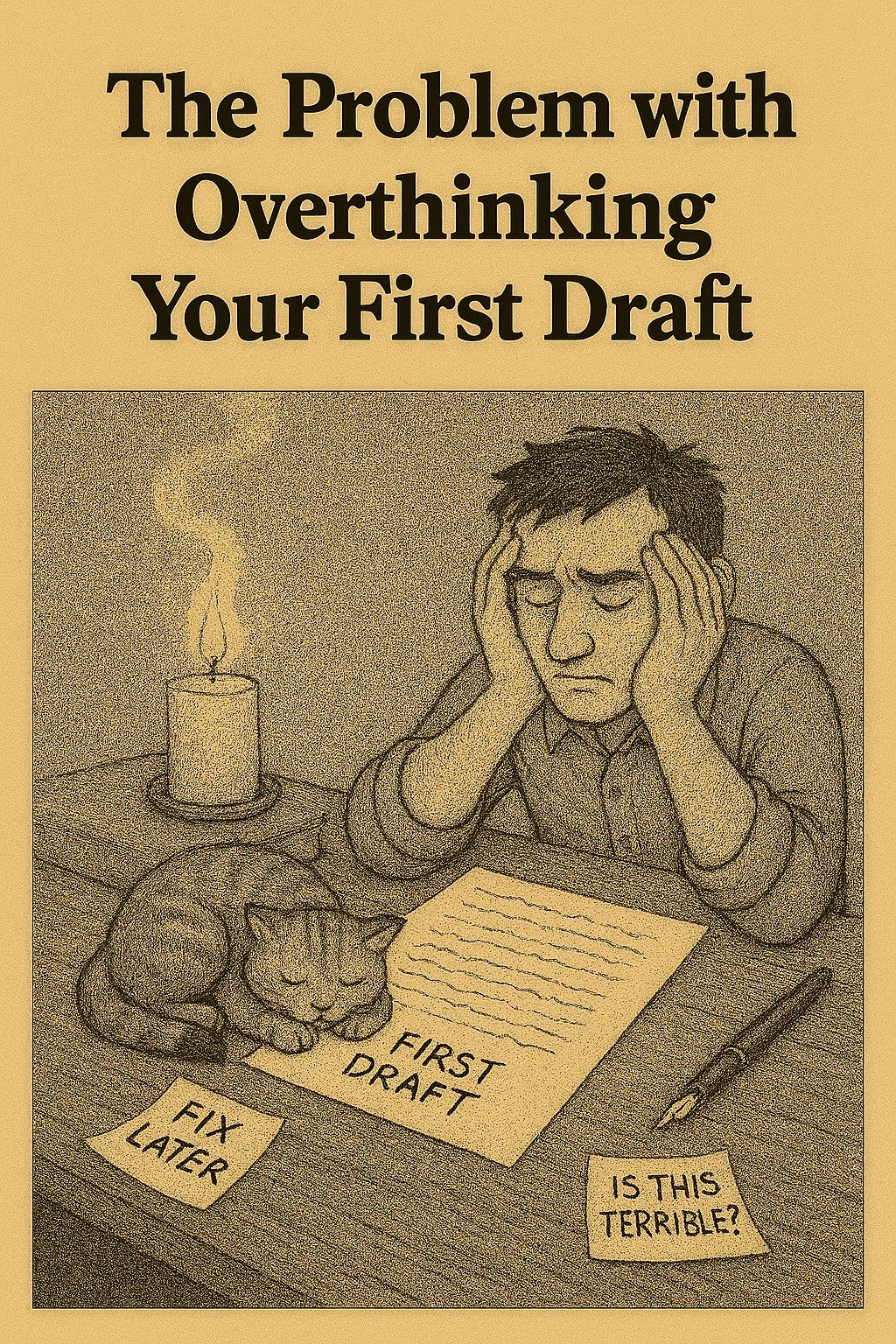
    You sit down to write. You have a scene in mind. A character. A mood. Maybe even a sentence that feels like a good start.

    And then the voice shows up.

    “Is this good enough?”
    “Should I outline more?”
    “What if this is terrible?”

    Suddenly, you’re not writing. You’re editing a sentence that doesn’t exist yet.

    Why Overthinking Feels Productive

    Because it wears a disguise. It looks like planning. It sounds like care. It feels like you’re being responsible.

    But really, it’s fear in a trench coat.

    Overthinking is the mind’s way of avoiding risk. And writing — especially first drafts — is all risk.

    What First Drafts Are Actually For

    They’re not for brilliance. They’re for discovery.

    A first draft is where you:

    • Find out what your story wants to be
    • Let your characters surprise you
    • Write the scene that makes no sense but feels right

    It’s not a performance. It’s a rehearsal.

    How to Write Badly (On Purpose)

    Try this:

    • Set a timer for 20 minutes and write without stopping
    • Use square brackets for anything you want to fix later
    • Start mid-scene, mid-conversation, mid-chaos

    Let it be messy. Let it be weird. Let it be yours.

    Closing Thought

    Overthinking is loud. But your draft is patient.

    It doesn’t need to be perfect. It just needs you to show up.

  • What Cartoons Taught Me About Storytelling

    What Cartoons Taught Me About Storytelling

    Cartoons were my first writing teachers. Not the respectable, literary mentors people like to name-drop in interviews — I’m talking Saturday morning chaos. Talking animals. Villains with capes that billowed even indoors. Sound effects that still echo in my brain like distant childhood thunder.

    And honestly? Those cartoons taught me more about storytelling than half the craft books on my shelf.

    Here’s what I mean.

    1. Timing is everything

    Cartoons understand rhythm better than anyone. A joke lands because of a half-second pause. A chase scene works because the beats are perfectly spaced. Even the emotional moments — yes, cartoons have those — rely on timing.

    When I write a scene now, I think in beats:

    • Set-up
    • Breath
    • Payoff

    If a moment feels flat, it’s usually because I rushed it or dragged it out. Cartoons taught me to trust the rhythm.

    2. Exaggeration reveals truth

    A character doesn’t have to be realistic to feel real. Sometimes exaggeration is the fastest way to show who someone is.

    Think about it:

    • The coward who jumps into the ceiling tiles at the slightest noise
    • The optimist who literally sparkles when they talk
    • The villain whose cape is always blowing in a dramatic wind that doesn’t exist

    These are big, silly choices — but they reveal personality instantly.

    In my writing, I let myself push a trait a little too far in the first draft. Later, I dial it back until it feels grounded but still vivid.

    3. Visual storytelling matters, even in prose

    Cartoons don’t have the luxury of long internal monologues. They show emotion through posture, color, movement, and expression.

    Writers can do the same.

    Instead of:

    “She was nervous.”

    Try:

    “She twisted the ring on her finger so hard it squeaked.”

    Cartoons taught me to write with a camera in my head — not to describe everything, but to choose the one detail that tells the truth.

    4. Heart beats plot every time

    The best cartoons sneak up on you. One minute you’re laughing at a talking toaster; the next, you’re crying because it just wants to be useful.

    Cartoons know that:

    • Characters matter more than twists
    • Emotion matters more than logic
    • Connection matters more than cleverness

    When I get stuck in a plot snarl, I ask myself: What does the character feel right now?
    Nine times out of ten, that’s the way forward.

    5. Playfulness is a writing tool

    Cartoons remind me not to take myself too seriously. Writing is work, yes — but it’s also play. It’s imagination with the volume turned up.

    When I let myself be playful:

    • My dialogue loosens
    • My characters breathe
    • My scenes surprise me

    And honestly? I have more fun.

    Final thought

    Cartoons taught me that storytelling isn’t about being serious — it’s about being sincere.
    It’s about rhythm, exaggeration, emotion, and joy.
    It’s about remembering that creativity starts with curiosity.

    So here’s to the animated chickens, the talking dogs, the villains with overly dramatic capes.
    They made me a better writer — and a happier one.

    Next week: “The Joys of Writing in a Small Town.”
    Spoiler: there are porch swings, gossip networks, and at least one raccoon.

  • When Characters Hijack the Plot

    Post 6 — March 7, 2026

    Blog Post: March 7, 2026

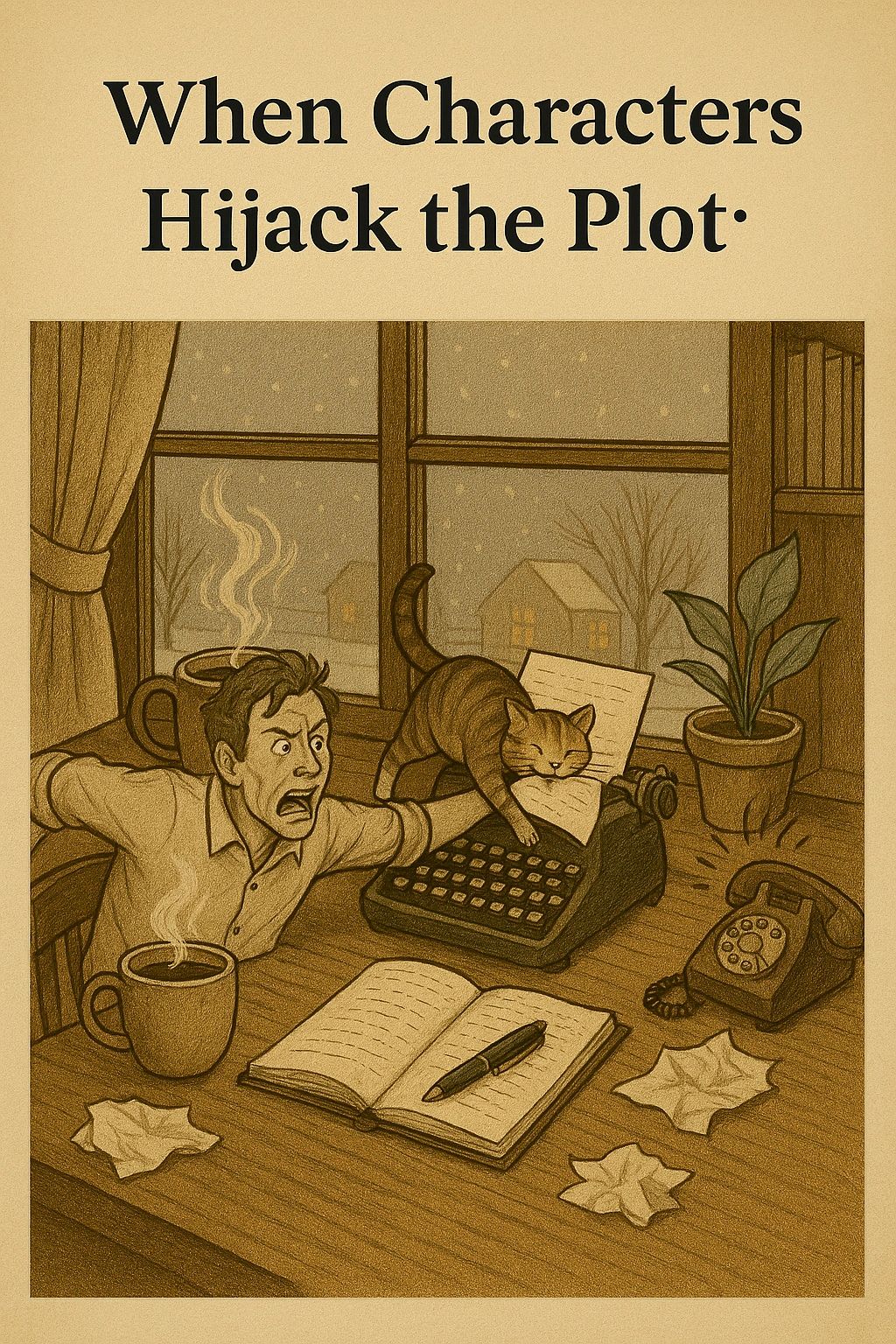
    When Your Characters Hijack the Plot

    You had a plan. A tidy outline. A clear arc. And then — somewhere between chapter three and the midpoint — your character took the wheel and veered off-road.

    The Moment It Happens

    It starts innocently enough. A line of dialogue that wasn’t in your notes. A reaction that feels too strong. Suddenly, your protagonist is making choices you didn’t authorize. They’re falling in love with the wrong person. They’re ignoring the inciting incident. They’re refusing to be heroic.

    And you — the writer — are left blinking at the page, wondering who’s really in charge here.

    Why It’s a Good Sign

    When characters hijack the plot, it means they’ve come alive. They’re no longer puppets dancing to your outline; they’re people with agency, contradictions, and inconvenient desires. That’s where the magic happens.

    Letting go of control can be terrifying. But it’s also the moment your story starts breathing.

    How to Navigate the Chaos

    • Listen first. What is your character trying to tell you?
    • Revisit your outline. Does it still serve the emotional truth of the story?
    • Don’t panic. You can always revise. But don’t squash the impulse too soon.

    Sometimes the detour is the real story. Sometimes the hijacker is the hero.

    Closing Thought

    If your character is tugging the plot in a new direction, maybe it’s not a hijacking. Maybe it’s a rescue.

    Creative Rituals That Actually Work

    Writers love rituals. We love them almost as much as we love procrastinating by researching rituals.

    We light candles.
    We brew tea.
    We rearrange our desks.
    We sharpen pencils we don’t actually use.
    We create playlists with titles like “Moody Forest Sorcerer Energy.”

    But which rituals actually help?

    Here’s what I’ve learned:
    The best creative rituals are the ones that signal your brain, “Hey, we’re doing the thing now.”

    It doesn’t matter if the ritual is elaborate or simple. What matters is consistency.

    Here are a few that genuinely work:

    1. The First Line Ritual

    Write one sentence — any sentence — to open the door to the work.

    2. The Five‑Minute Promise

    Tell yourself you only have to write for five minutes.
    You’ll almost always keep going.

    3. The Sensory Anchor

    A candle, a specific mug, a certain song — something that becomes shorthand for “writing mode.”

    4. The Gentle Ending

    Stop before you’re empty. Leave a breadcrumb for tomorrow.

    Creative rituals aren’t magic spells. They’re small kindnesses we offer our future selves. They make the work feel less like a battle and more like a return.

    And in February — the month of slow starts and quiet persistence — that’s exactly what we need.

  • The Writing Advice I Ignore (and Why You Should Too)

    The Writing Advice I Ignore (and Why You Should Too)

    March 7, 2026

    There’s a special kind of guilt reserved for writers who ignore advice. It creeps in when you skip the outline, when you write dialogue that’s too clever, or when you dare to tell instead of show. It whispers, “You should know better.”

    But here’s the truth: not all advice is sacred. Some of it is helpful. Some of it is outdated. And some of it is just plain wrong—for you.

    1. “Show, Don’t Tell”

    This one’s practically scripture. And yes, showing can be powerful. But sometimes, telling is efficient, elegant, and emotionally direct. I don’t need to show you every tear when I can say, “She was heartbroken.” That’s not lazy—it’s clarity.

    2. “Write Every Day”

    I tried. I failed. I felt terrible. Then I realized: writing is not a punishment. It’s a practice. And like any practice, it needs rest, reflection, and room to breathe. I write most days. But not all. And that’s okay.

    3. “Kill Your Darlings”

    I’ve murdered a few metaphors in my time. But I’ve also kept some darlings alive because they made me laugh, or cry, or remember why I started writing in the first place. Not every darling deserves the guillotine.

    4. “Start with a Hook”

    Hooks are great. But sometimes, I want to start with a whisper. A quiet moment. A slow build. Not every reader needs fireworks in the first sentence. Some are willing to linger.

    5. “Write What You Know”

    I write what I feel. What I wonder. What I want to understand. That’s not always what I know. And that’s the point.

    Writing advice is like seasoning. Use what enhances the flavor. Ignore what overwhelms it. And remember: the recipe is yours.

    Signed with a smirk — Dean Burgess

  • How to Build a Writing Habit Without Becoming a Robot

    How to Build a Writing Habit Without Becoming a Robot

    I’ve tried every writing habit trick in the book. Timers. Word count goals. Color-coded spreadsheets. Once, I even made a sticker chart like I was a kindergartener trying to earn a trip to the zoo.

    Some of it worked. Some of it made me feel like a productivity robot with a coffee addiction.

    Here’s what I’ve learned about building a writing habit that actually sticks — and still feels human.

    1. Ritual beats routine

    Routine is rigid. Ritual is meaningful.

    Instead of “write 500 words by 8:00 a.m.,” I light a candle, pour coffee into my favorite chipped mug, and open the same notebook I’ve been scribbling in since last fall. It’s not about the word count — it’s about showing up.

    2. Make it small enough to succeed

    Some days, “write a novel” feels like “build a rocket ship.” So I shrink the goal.

    • Write one sentence.
    • Jot down a weird dream.
    • Describe the sound of the neighbor’s lawnmower.

    Once I start, I usually keep going. But even if I don’t — I showed up.

    3. Track progress like a human, not a machine

    I used to log every writing session in a spreadsheet. Then I realized I was spending more time updating cells than writing.

    Now I track progress with a weekly check-in:

    • Did I write?
    • Did I enjoy it?
    • Did I learn anything?

    If the answer to two out of three is “yes,” I’m doing fine.

    4. Let the habit flex

    Life happens. Schedules change. Muses go on vacation.

    Instead of punishing myself for missing a day, I treat it like a skipped stretch — not a failure. I pick up where I left off. I write in the car. I write on a napkin. I write badly. But I write.

    Final thought

    A writing habit should feel like a relationship — not a job.
    It should be something you return to with curiosity, not dread.
    It should make you feel more like yourself, not less.

    So build the habit. But keep the soul.

    Thanks for reading — next week, we’ll talk about cartoons, timing, and what animated chickens taught me about storytelling.

  • The Quiet Rituals That Make Me Feel Like a Writer Again

    The Quiet Rituals That Make Me Feel Like a Writer Again

    March 3, 2026

    Some days, writing feels like trying to tune a radio that only picks up static. I sit down with the best intentions, crack my knuckles like a professional, and… nothing. Not even a whisper of an idea. Just the hum of the refrigerator and the cat loudly grooming herself like she’s preparing for a magazine shoot.

    But then there are the rituals — the small, steady things that coax me back into feeling like a writer again. Not because they’re magical, but because they remind me that writing isn’t a lightning strike. It’s a practice. A rhythm. A way of showing up.

    The Mug That Means Business

    I have a particular mug — heavy, chipped, and shaped like it was designed by someone who believed in the structural integrity of soup bowls. When I wrap my hands around it, something in my brain goes, Ah. We’re doing this.
    It’s not the coffee. It’s the cue.

    The Notebook That Doesn’t Judge

    There’s a notebook I keep just for warm-up writing. No goals. No pressure. Just a place to let my brain stretch before it tries to sprint. Half the pages are nonsense. Some are grocery lists. One page simply says “WHY???” in increasingly dramatic handwriting.
    But it works. It gets me moving.

    The Cat Who Thinks She’s My Editor

    Every writer needs an editor who is both supportive and deeply unhelpful. Mine weighs eleven pounds and believes the typewriter exists solely as a heated mattress.
    When she curls up on the keys, I take it as a sign: slow down. Breathe. Don’t take yourself so seriously.
    (Also: buy canned food. Immediately.)

    The Ritual of Returning

    These rituals don’t make me a better writer. They make me a present one. They remind me that writing isn’t about waiting for inspiration to arrive fully dressed and punctual. It’s about creating the conditions where inspiration might wander in, curious, sniff around, and decide to stay a while.

    And on the days when it doesn’t?
    Well, at least the coffee is warm, the notebook is open, and the cat is purring like she’s proud of me.

    Signed with steam and silence —
    Dean Burgess

  • The Advice I Ignore (And Why It Works for Me)

    The Advice I Ignore (And Why It Works for Me)

    April 24, 2026

    There’s a special kind of freedom in ignoring advice. Not out of arrogance — but out of experience. Over time, you learn which rules help and which ones just get in the way. And sometimes, the advice you ignore becomes the very thing that helps you grow.

    Advice I’ve learned to ignore

    • “Write every day.” I don’t. I write when I’m ready, and I rest when I need to.
    • “Kill your darlings.” Some darlings deserve to live. They’re the heart of the piece.
    • “Show, don’t tell.” Sometimes, telling is faster, funnier, and more honest.
    • “Don’t use adverbs.” Really? Passionately? Occasionally? I like them. Sparingly.

    Advice is a tool, not a law. And tools should fit the hand that’s using them.

    Why ignoring advice can be smart

    When you ignore advice, you’re not rejecting wisdom — you’re choosing your own path. You’re saying:

    • I know what works for me
    • I trust my instincts
    • I’m willing to experiment
    • I’m not afraid to fail

    That’s not rebellion. That’s growth.

    The cat’s editorial stance

    Today, the cat knocked a writing book off the shelf, then sat on the page that said “Never start with dialogue.” I took that as permission. The next scene I wrote began with a line of dialogue and ended with a sense of relief.

    𝓢𝓲𝓰𝓷𝓮𝓭 𝔀𝓱𝓲𝓵𝓮 𝓽𝓱𝓮 𝓬𝓪𝓽 𝓽𝓻𝓲𝓮𝓭 𝓽𝓸 𝓮𝓭𝓲𝓽 𝓶𝔂 𝓻𝓾𝓵𝓮𝓼 — 𝓓𝓮𝓪𝓷 𝓑𝓾𝓻𝓰𝓮ss

  • Creative Rituals That Actually Work

    Post 4 — February 28, 2026

    Creative Rituals That Actually Work

    Writers love rituals. We love them almost as much as we love procrastinating by researching rituals.

    We light candles.
    We brew tea.
    We rearrange our desks.
    We sharpen pencils we don’t actually use.
    We create playlists with titles like “Moody Forest Sorcerer Energy.”

    But which rituals actually help?

    Here’s what I’ve learned:
    The best creative rituals are the ones that signal your brain, “Hey, we’re doing the thing now.”

    It doesn’t matter if the ritual is elaborate or simple. What matters is consistency.

    Here are a few that genuinely work:

    1. The First Line Ritual

    Write one sentence — any sentence — to open the door to the work.

    2. The Five‑Minute Promise

    Tell yourself you only have to write for five minutes.
    You’ll almost always keep going.

    3. The Sensory Anchor

    A candle, a specific mug, a certain song — something that becomes shorthand for “writing mode.”

    4. The Gentle Ending

    Stop before you’re empty. Leave a breadcrumb for tomorrow.

    Creative rituals aren’t magic spells. They’re small kindnesses we offer our future selves. They make the work feel less like a battle and more like a return.

    And in February — the month of slow starts and quiet persistence — that’s exactly what we need.