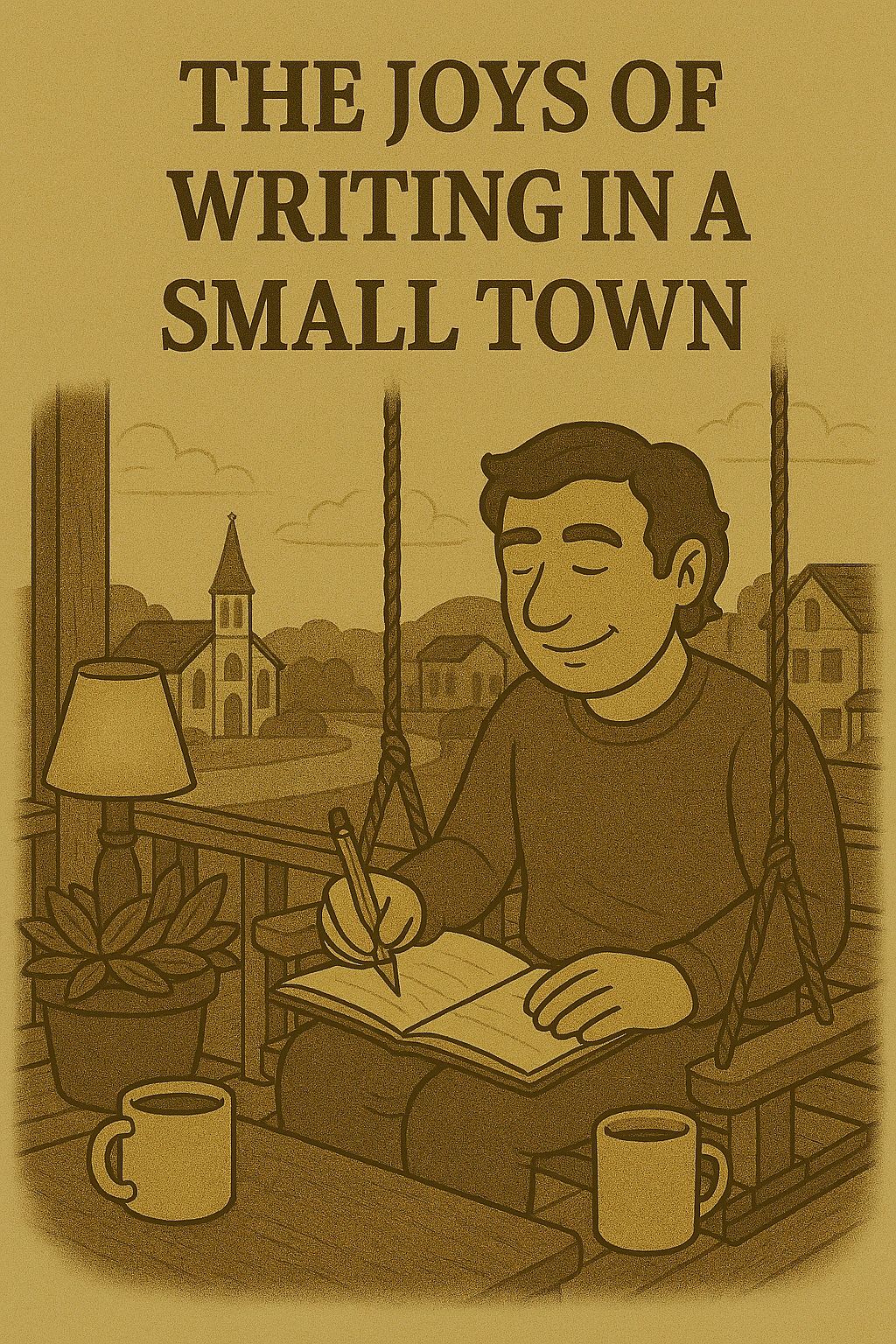
The Joys of Writing in a Small Town
There’s something about writing in a small town that feels like cheating — in the best possible way.
You don’t have to invent quirky characters. They walk past your porch every morning.
You don’t have to imagine dramatic tension. Just go to the post office and ask about the raccoon incident.
You don’t have to create atmosphere. It’s already there — in the creak of the diner booth, the gossip at the hardware store, and the way the sky turns lavender before a storm.
Here’s what I love most about writing in a small town.
1. Everyone’s a character
There’s the retired teacher who walks her cat on a leash.
The teenager who sells homemade candles and knows everyone’s birthday.
The man who insists on mowing his lawn in a three-piece suit.
You couldn’t make these people up — and you don’t have to.
They’re generous with their quirks. They lend them out freely.
All you have to do is pay attention.
2. The setting does half the work
Small towns come with built-in atmosphere:
- Porch swings and wind chimes
- Church bells and train whistles
- Sidewalks that remember every shoe that’s ever walked them
When I write, I borrow the texture of this place.
The slow rhythm. The soft edges. The way everything feels just a little bit haunted — but in a friendly way.
3. Gossip is plot gold
In a small town, gossip isn’t just entertainment — it’s infrastructure.
It travels faster than Wi-Fi.
It’s more accurate than the weather app.
It’s full of twists, turns, and emotional stakes.
I don’t write real gossip into my stories (I like being invited to potlucks), but I do borrow the structure:
- A secret
- A misunderstanding
- A reveal
- A reconciliation over pie
It’s storytelling in its purest form.
4. Quiet is a creative superpower
There’s a kind of quiet here that isn’t silence — it’s space.
Space to think.
Space to listen.
Space to let a sentence breathe before you write the next one.
I’ve written in cities. I’ve written in airports. I’ve written in coffee shops with playlists curated by caffeinated DJs.
But nothing beats the quiet of a small town morning, when the only sound is a bird arguing with a squirrel.
Final thought
Writing in a small town feels like writing with a co-author — one who provides characters, setting, and mood without asking for credit.
It’s not perfect. Sometimes the Wi-Fi goes out. Sometimes the raccoons get into the recycling.
But it’s rich. It’s textured. It’s alive.
And it reminds me that stories don’t have to be invented from scratch.
Sometimes, they just need to be noticed.
Next week: “The Writing Advice I Actually Use.” Spoiler: it’s not “write every day.”