By the time we were old enough to understand what death meant, Grandaddy Burgess had already buried half the county.
That sounds dramatic, but on a farm, death is just another season. Spring meant planting, summer meant plowing or praying for rain, and come fall and winter you were either cutting timber, running the sawmill, or repairing everything that broke so you’d be ready when spring came roaring back. There was always something to do. Always.
But some things, once done, don’t stay buried.
Grandaddy told the story every October, when the evenings turned sharp and the harvest moon hung low and orange over the fields. He’d gather us on the back porch-me and my brothers Brian and David, and our cousins James, Cindy, Andy, and Lee-and wait until the wind made the porch swing creak like a coffin lid. Then he’d start.
“It was October,” he’d say, “same time of year as now. I was headed to town for tractor parts.”
The highway sat two miles down the dirt road from the farmhouse. Grandaddy made the trip in his Ford truck, bouncing through ruts hardened by the first cold snaps, until he turned onto the asphalt and the world smoothed out.
He’d gone maybe a mile when he saw her.
She lay on the shoulder of the road, crumpled like a discarded coat. A young woman, maybe twenty, her dark hair matted with blood, her dress torn and dusty. Grandaddy stopped the truck and knelt beside her, pressing two fingers to her throat even though he already knew. The blood on her skin had gone cold. The blood on the road had not.
He drove to the nearest store-a filling station with one phone-and called the sheriff and ambulance. They arrived with lights spinning uselessly against the afternoon sky, because there was nothing to save. She’d been hit by a car in the middle of the night, they figured. Probably never saw it coming.
But she hadn’t died right away.
The sheriff’s deputies followed the blood trail for more than a mile along the highway, marking the asphalt with chalk at every dark smear, every handprint where she’d dragged herself forward. She’d crawled through the darkness, alone and broken, searching for help that never came.
The ambulance took her away in a zippered bag. Later came the investigation, the autopsy, the newspaper articles that went nowhere. No one knew who she was. No one knew who hit her. She was a ghost before she ever became one.
Grandaddy asked the sheriff what would happen to her.
“Potter’s field,” the sheriff said. “County buries the unknowns there. No family, no name, no stone. Just a number in a book somewhere.”
Grandaddy couldn’t stomach it.
The Burgess family had maintained a small cemetery for generations at the top of a hill in the middle of our north field. Nothing grand-just a few weathered tombstones from the 1800s, a small patch of trees that had grown up around the dead, and the quiet that comes from being forgotten by everyone except those who tend the graves.
Grandaddy cleared it with the county. He’d bury her there, he said. Place a small marker. Take care of her grave like he did the rest of the family. Better than leaving her alone in an unmarked ditch with strangers.
They agreed.
The family held a small service. Just Grandaddy, a preacher from the next county, and a plain wooden coffin that the county provided. He carved her a simple headstone: UNKNOWN WOMAN, OCTOBER 1947. MAY SHE FIND REST.
But rest, Grandaddy would tell us with a strange look in his eyes, was not what she found.
“Warm October evenings,” Grandaddy said, his voice dropping to a whisper that made us lean in despite ourselves. “When the air’s still thick from summer but the night’s coming on cold. If you watch from the hill about a hundred yards away-just there, where the old fence line runs-you can see her come up from the grave.”
We were eight, nine, ten years old. We believed every word. Brian would sleep with the covers pulled to his chin. David started keeping a flashlight under his pillow. Cindy cried at night for a week after first hearing it. Andy and Lee swore they weren’t scared, but they never walked past that field after sunset. And me? I lay awake listening to every creak of the old farmhouse, convinced I could hear dragging footsteps in the corn.
James, though.
James was different.
James was feral, Grandmother always said, though she meant it kindly. He ran wild through the woods, came home with ticks in his hair and mud in his ears, laughed at things that made other kids cry. He wasn’t brave so much as he was untamed-too wild to understand fear the way the rest of us did.
By the time I turned twelve, the story had become a dare. Every October, as Halloween approached, we’d challenge each other. Who was brave enough to walk up to the cemetery at dusk? Who would stand among the old tombstones as the light failed?
We’d never actually done it. We’d walked to the fence line at sunset, sure, peered through the trees at the small clearing where the stones stood. But none of us had ever crossed into the cemetery itself. Not close to dark.
Until James took the challenge.
It was October 28th, I remember, because Halloween fell on a Friday that year and we were counting down the days like Christmas. The afternoon had been unseasonably warm-seventy degrees, the air heavy and still, the kind of October evening Grandaddy had described a hundred times.
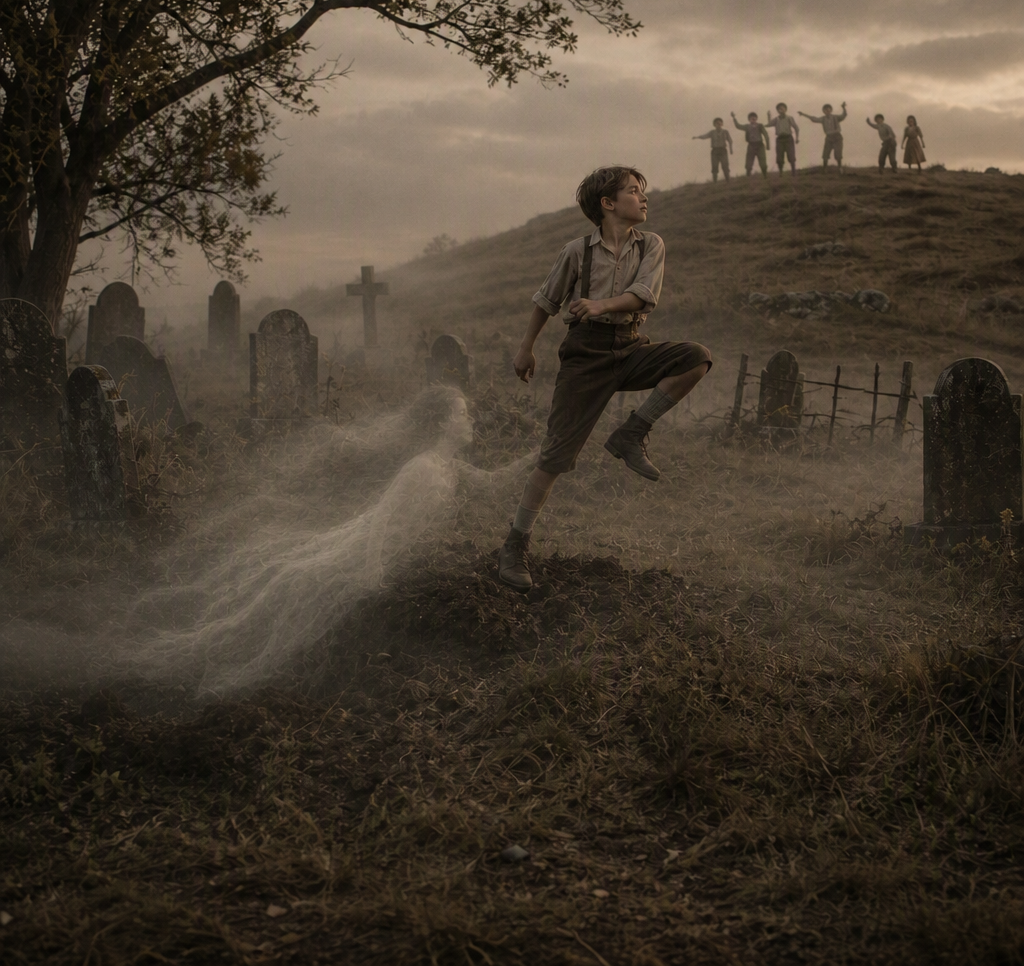
We stood on the far hill, the seven of us, watching James walk across the field toward the cemetery. He moved with that loose, careless stride of his, hands in his pockets, occasionally looking back to flash us a grin that said you’re all babies.
“He’s gonna chicken out,” Brian muttered, though he didn’t sound convinced.
“He’s gonna die,” Cindy whispered, and Andy punched her arm.
“Shut up, Cindy. There’s no such thing as ghosts.”
“Then you go,” she shot back.
Andy didn’t answer.
James reached the tree line and disappeared into the shadows of the small grove. We watched from our hill, squinting against the dying light. After a moment, we could see him again through the trees-just a shape, but unmistakably James. He found a fallen log near the edge of the clearing and sat down, arms spread along the wood behind him, legs stretched out like he was lounging at a picnic.
“See?” David said, his voice too loud. “Nothing’s happening. Grandaddy’s full of-”
“Shh,” I said.
Twilight came on fast, the way it does in autumn. One minute the sky burned orange and purple, the next the world turned to gray. James stood up from his log and walked to the unknown woman’s grave. He stood beside her marker, looking down at it, then turned to face us. Even from a hundred yards, I could see his grin.
“He’s dancing,” Lee breathed.
And he was. James had started to move, a slow, mocking shuffle, arms swinging, head bobbing. He was dancing beside the grave of a woman who’d crawled a mile to die, and he was laughing while he did it.
“James!” I screamed. “James, run!”
“Run!” Brian joined in, then David, then all of us, our voices carrying across the field in a chorus of panic. “Run, James, run!”
He just danced faster, laughing at what he thought was our attempt to scare him. He couldn’t hear the real terror. Couldn’t see what we could see from our hill.
The mist started at the base of her headstone. Just a thin vapor at first, rising from the earth like breath on a cold morning. Then it thickened, swirling around James’s ankles while he danced, oblivious.
“RUN!” we shrieked, our voices breaking, tears streaming down Cindy’s face.
The mist took shape.
A hand emerged from the ground-pale, bloodied, fingers clawing at the dirt. Then an arm, reaching upward, grasping. James kept dancing.
The earth heaved. Shoulders rose, then a head with matted dark hair, then the full form of a young woman pulling herself from her grave with the same desperate determination she’d once crawled along a highway. She reached for James’s legs, her bloodied fingers inches from his dancing feet.
Something in our voices finally broke through. Maybe it was the pitch of true terror, the sound of seven children screaming not with mischief but with genuine fear. James stopped dancing. He looked at our hill, at our waving arms, our pointing fingers. Then he looked down.
He saw nothing. The mist, the reaching woman, the grave itself-they were invisible to him. But he saw our faces. He heard the horror in our throats.
James ran.
He bolted from the cemetery like a startled deer, legs pumping, arms windmilling, crashing through the underbrush and across the field. He didn’t look back. None of us would have either.
He reached our hill gasping, bent over with his hands on his knees. “You… you stupid…” he panted. “Trying to… scare me…”
“Didn’t you see it?” I grabbed his shoulders, shaking him. “Didn’t you see her?”
“See what? There was nothing there! I was dancing and you all started screaming like-”
“She came out of the grave,” Brian said, his voice flat and strange. “She reached for you. Her hand was right there, James. Right by your leg.”
“You’re lying.” But James looked back at the cemetery, and the trees had gone completely dark. The last of the light had died while he ran, and the grove was just a black shape against a purple sky.
“We all saw it,” Cindy whispered. “All of us.”
James didn’t speak for a long moment. Then: “I didn’t see anything. Not a thing.”
But his voice had changed. The wildness had gone quiet.
We never went near the Burgess cemetery after dark again. Not any of us. James, for all his feral courage, would take the long way around rather than pass within sight of those trees. Cindy had nightmares for years. Andy and Lee stopped claiming ghosts weren’t real, though they never admitted they believed either.
And me? I thought about that young woman often. About crawling through darkness, searching for help. About being buried with strangers, then pulled back by whatever force keeps the dead from resting easy. I wondered if Grandaddy had done her a kindness by giving her a named grave, or if he’d only given her a place to return to.
Grandaddy died in the spring, when the planting was just beginning. We buried him in the Burgess cemetery, not far from the unknown woman. I visit when I’m back home, clear the weeds, make sure the stones are upright. Both of theirs.
Sometimes, on warm October evenings, I stand on the far hill and watch. I’ve never seen her again. But I’ve felt the mist on my ankles. I’ve heard the soft, desperate sound of something dragging itself through fallen leaves.
And I’ve learned that some kindnesses don’t end with death. That taking care of the dead means more than keeping their graves tidy. It means remembering them. Speaking their stories. Keeping them from being forgotten in unmarked places, alone in the dark, crawling toward help that never comes.
The unknown woman has a name now, in our family. We call her the Crawling Woman. And every Halloween, when the air turns warm and strange and the night comes on too fast, we tell her story. We speak of her crawling. We remember her reaching.
We keep her from being alone.
And sometimes, if you stand on the right hill and the light is failing just so, you can see the mist rise from her grave. Not every year. But often enough.
Often enough to know that some stories aren’t meant to end.
They’re meant to be told, generation after generation, whispered between children who huddle close and swear they saw something impossible, something that reached from the earth with bloody fingers and desperate eyes.
Something that crawls still, searching for what we all want in the end.
Not to be forgotten.
Not to be alone.
For Grandaddy Burgess, who took care of the dead, and for the woman who taught us that some graves are never truly at rest.