Category: Short Stories and Poems

A cozy collection of short fiction and poetry, gathered for quiet moments and lingering thoughts.

  • The Crawling Woman

    The Crawling Woman

    By the time we were old enough to understand what death meant, Grandaddy Burgess had already buried half the county.

    That sounds dramatic, but on a farm, death is just another season. Spring meant planting, summer meant plowing or praying for rain, and come fall and winter you were either cutting timber, running the sawmill, or repairing everything that broke so you’d be ready when spring came roaring back. There was always something to do. Always.

    But some things, once done, don’t stay buried.

    Grandaddy told the story every October, when the evenings turned sharp and the harvest moon hung low and orange over the fields. He’d gather us on the back porch-me and my brothers Brian and David, and our cousins James, Cindy, Andy, and Lee-and wait until the wind made the porch swing creak like a coffin lid. Then he’d start.

    “It was October,” he’d say, “same time of year as now. I was headed to town for tractor parts.”

    The highway sat two miles down the dirt road from the farmhouse. Grandaddy made the trip in his Ford truck, bouncing through ruts hardened by the first cold snaps, until he turned onto the asphalt and the world smoothed out.

    He’d gone maybe a mile when he saw her.

    She lay on the shoulder of the road, crumpled like a discarded coat. A young woman, maybe twenty, her dark hair matted with blood, her dress torn and dusty. Grandaddy stopped the truck and knelt beside her, pressing two fingers to her throat even though he already knew. The blood on her skin had gone cold. The blood on the road had not.

    He drove to the nearest store-a filling station with one phone-and called the sheriff and ambulance. They arrived with lights spinning uselessly against the afternoon sky, because there was nothing to save. She’d been hit by a car in the middle of the night, they figured. Probably never saw it coming.

    But she hadn’t died right away.

    The sheriff’s deputies followed the blood trail for more than a mile along the highway, marking the asphalt with chalk at every dark smear, every handprint where she’d dragged herself forward. She’d crawled through the darkness, alone and broken, searching for help that never came.

    The ambulance took her away in a zippered bag. Later came the investigation, the autopsy, the newspaper articles that went nowhere. No one knew who she was. No one knew who hit her. She was a ghost before she ever became one.

    Grandaddy asked the sheriff what would happen to her.

    “Potter’s field,” the sheriff said. “County buries the unknowns there. No family, no name, no stone. Just a number in a book somewhere.”

    Grandaddy couldn’t stomach it.

    The Burgess family had maintained a small cemetery for generations at the top of a hill in the middle of our north field. Nothing grand-just a few weathered tombstones from the 1800s, a small patch of trees that had grown up around the dead, and the quiet that comes from being forgotten by everyone except those who tend the graves.

    Grandaddy cleared it with the county. He’d bury her there, he said. Place a small marker. Take care of her grave like he did the rest of the family. Better than leaving her alone in an unmarked ditch with strangers.

    They agreed.

    The family held a small service. Just Grandaddy, a preacher from the next county, and a plain wooden coffin that the county provided. He carved her a simple headstone: UNKNOWN WOMAN, OCTOBER 1947. MAY SHE FIND REST.

    But rest, Grandaddy would tell us with a strange look in his eyes, was not what she found.

    “Warm October evenings,” Grandaddy said, his voice dropping to a whisper that made us lean in despite ourselves. “When the air’s still thick from summer but the night’s coming on cold. If you watch from the hill about a hundred yards away-just there, where the old fence line runs-you can see her come up from the grave.”

    We were eight, nine, ten years old. We believed every word. Brian would sleep with the covers pulled to his chin. David started keeping a flashlight under his pillow. Cindy cried at night for a week after first hearing it. Andy and Lee swore they weren’t scared, but they never walked past that field after sunset. And me? I lay awake listening to every creak of the old farmhouse, convinced I could hear dragging footsteps in the corn.

    James, though.

    James was different.

    James was feral, Grandmother always said, though she meant it kindly. He ran wild through the woods, came home with ticks in his hair and mud in his ears, laughed at things that made other kids cry. He wasn’t brave so much as he was untamed-too wild to understand fear the way the rest of us did.

    By the time I turned twelve, the story had become a dare. Every October, as Halloween approached, we’d challenge each other. Who was brave enough to walk up to the cemetery at dusk? Who would stand among the old tombstones as the light failed?

    We’d never actually done it. We’d walked to the fence line at sunset, sure, peered through the trees at the small clearing where the stones stood. But none of us had ever crossed into the cemetery itself. Not close to dark.

    Until James took the challenge.

    It was October 28th, I remember, because Halloween fell on a Friday that year and we were counting down the days like Christmas. The afternoon had been unseasonably warm-seventy degrees, the air heavy and still, the kind of October evening Grandaddy had described a hundred times.

    We stood on the far hill, the seven of us, watching James walk across the field toward the cemetery. He moved with that loose, careless stride of his, hands in his pockets, occasionally looking back to flash us a grin that said you’re all babies.

    “He’s gonna chicken out,” Brian muttered, though he didn’t sound convinced.

    “He’s gonna die,” Cindy whispered, and Andy punched her arm.

    “Shut up, Cindy. There’s no such thing as ghosts.”

    “Then you go,” she shot back.

    Andy didn’t answer.

    James reached the tree line and disappeared into the shadows of the small grove. We watched from our hill, squinting against the dying light. After a moment, we could see him again through the trees-just a shape, but unmistakably James. He found a fallen log near the edge of the clearing and sat down, arms spread along the wood behind him, legs stretched out like he was lounging at a picnic.

    “See?” David said, his voice too loud. “Nothing’s happening. Grandaddy’s full of-”

    “Shh,” I said.

    Twilight came on fast, the way it does in autumn. One minute the sky burned orange and purple, the next the world turned to gray. James stood up from his log and walked to the unknown woman’s grave. He stood beside her marker, looking down at it, then turned to face us. Even from a hundred yards, I could see his grin.

    “He’s dancing,” Lee breathed.

    And he was. James had started to move, a slow, mocking shuffle, arms swinging, head bobbing. He was dancing beside the grave of a woman who’d crawled a mile to die, and he was laughing while he did it.

    “James!” I screamed. “James, run!”

    “Run!” Brian joined in, then David, then all of us, our voices carrying across the field in a chorus of panic. “Run, James, run!”

    He just danced faster, laughing at what he thought was our attempt to scare him. He couldn’t hear the real terror. Couldn’t see what we could see from our hill.

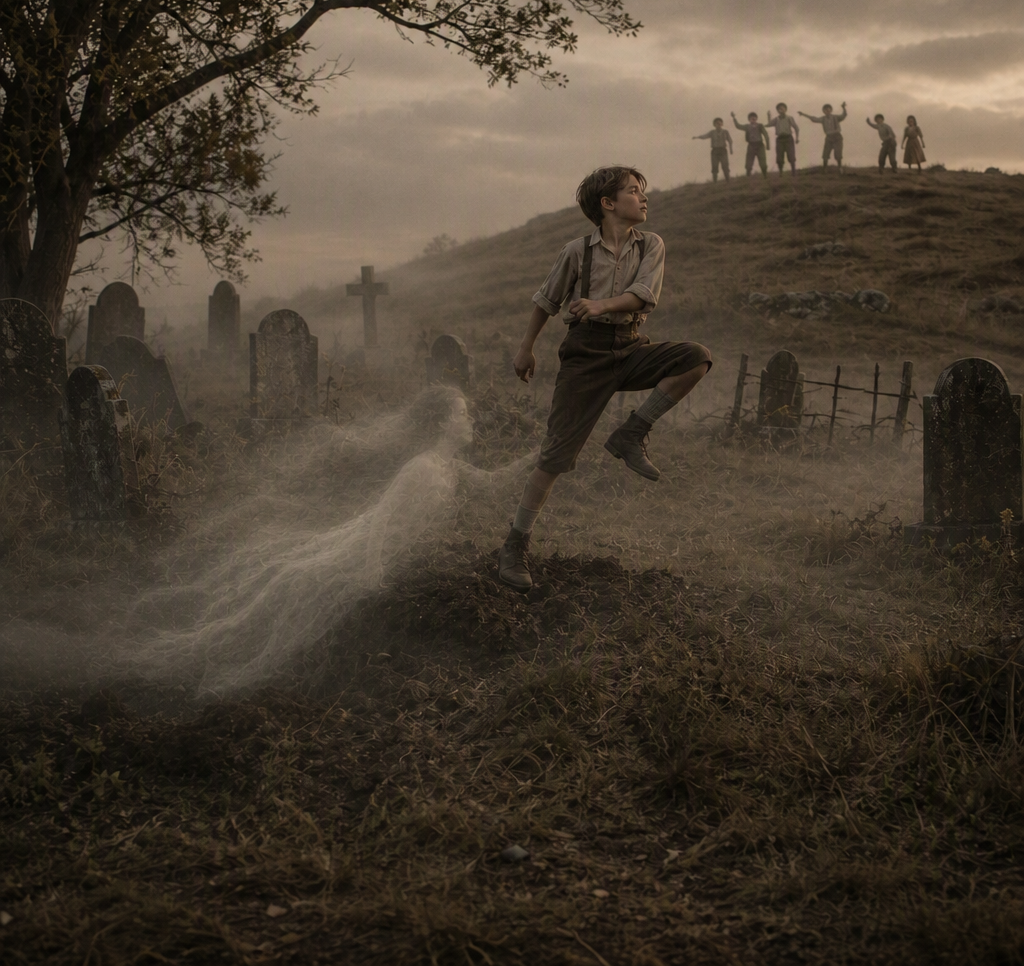
    The mist started at the base of her headstone. Just a thin vapor at first, rising from the earth like breath on a cold morning. Then it thickened, swirling around James’s ankles while he danced, oblivious.

    “RUN!” we shrieked, our voices breaking, tears streaming down Cindy’s face.

    The mist took shape.

    A hand emerged from the ground-pale, bloodied, fingers clawing at the dirt. Then an arm, reaching upward, grasping. James kept dancing.

    The earth heaved. Shoulders rose, then a head with matted dark hair, then the full form of a young woman pulling herself from her grave with the same desperate determination she’d once crawled along a highway. She reached for James’s legs, her bloodied fingers inches from his dancing feet.

    Something in our voices finally broke through. Maybe it was the pitch of true terror, the sound of seven children screaming not with mischief but with genuine fear. James stopped dancing. He looked at our hill, at our waving arms, our pointing fingers. Then he looked down.

    He saw nothing. The mist, the reaching woman, the grave itself-they were invisible to him. But he saw our faces. He heard the horror in our throats.

    James ran.

    He bolted from the cemetery like a startled deer, legs pumping, arms windmilling, crashing through the underbrush and across the field. He didn’t look back. None of us would have either.

    He reached our hill gasping, bent over with his hands on his knees. “You… you stupid…” he panted. “Trying to… scare me…”

    “Didn’t you see it?” I grabbed his shoulders, shaking him. “Didn’t you see her?”

    “See what? There was nothing there! I was dancing and you all started screaming like-”

    “She came out of the grave,” Brian said, his voice flat and strange. “She reached for you. Her hand was right there, James. Right by your leg.”

    “You’re lying.” But James looked back at the cemetery, and the trees had gone completely dark. The last of the light had died while he ran, and the grove was just a black shape against a purple sky.

    “We all saw it,” Cindy whispered. “All of us.”

    James didn’t speak for a long moment. Then: “I didn’t see anything. Not a thing.”

    But his voice had changed. The wildness had gone quiet.

    We never went near the Burgess cemetery after dark again. Not any of us. James, for all his feral courage, would take the long way around rather than pass within sight of those trees. Cindy had nightmares for years. Andy and Lee stopped claiming ghosts weren’t real, though they never admitted they believed either.

    And me? I thought about that young woman often. About crawling through darkness, searching for help. About being buried with strangers, then pulled back by whatever force keeps the dead from resting easy. I wondered if Grandaddy had done her a kindness by giving her a named grave, or if he’d only given her a place to return to.

    Grandaddy died in the spring, when the planting was just beginning. We buried him in the Burgess cemetery, not far from the unknown woman. I visit when I’m back home, clear the weeds, make sure the stones are upright. Both of theirs.

    Sometimes, on warm October evenings, I stand on the far hill and watch. I’ve never seen her again. But I’ve felt the mist on my ankles. I’ve heard the soft, desperate sound of something dragging itself through fallen leaves.

    And I’ve learned that some kindnesses don’t end with death. That taking care of the dead means more than keeping their graves tidy. It means remembering them. Speaking their stories. Keeping them from being forgotten in unmarked places, alone in the dark, crawling toward help that never comes.

    The unknown woman has a name now, in our family. We call her the Crawling Woman. And every Halloween, when the air turns warm and strange and the night comes on too fast, we tell her story. We speak of her crawling. We remember her reaching.

    We keep her from being alone.

    And sometimes, if you stand on the right hill and the light is failing just so, you can see the mist rise from her grave. Not every year. But often enough.

    Often enough to know that some stories aren’t meant to end.

    They’re meant to be told, generation after generation, whispered between children who huddle close and swear they saw something impossible, something that reached from the earth with bloody fingers and desperate eyes.

    Something that crawls still, searching for what we all want in the end.

    Not to be forgotten.

    Not to be alone.

    For Grandaddy Burgess, who took care of the dead, and for the woman who taught us that some graves are never truly at rest.

  • Vanishing In The Rain…

    A person cannot simply vanish into the rain, but I tried. I was ten years old and certain, the way only a child can be, that I could evade the surveillance state of Burgess cousins and brothers by clever arrangement of my body in space and time. My body: angular, shinned, elbowed, perpetually scraped. My time: parceled into precise increments by the chimes of Grandmama’s kitchen clock and the insistent air horn of Granddaddy’s pickup returning from the John Deere in Monetta.

    I would wait for my moment. While the boys performed their barnyard theatre of wrestling and clod-hurling out under the lone patch of sourwoods, I’d slip behind the clapboard wedge of the smokehouse, arms loaded with contraband—an ancient Zebco 33, a battered tackle box pilfered from Grandaddy’s shed, and a lidded cardboard tube pulsing with frenetic crickets. By then, the air had thickened into the viscous near-rain of a South Carolina summer, the clouds so low I could have ladled them with a soup spoon. I liked the rain before it arrived, the tense static of it. I liked the scent of it in the air, sharp and mineral, like old pennies and the soft green rot of damp earth.

    No one ever told the truth about the Burgess farm: that the landscape itself was as cunning as the children, riddled with secret currencies and shifting borders. The creek, Chinquapin, was my favored territory, the one place the older boys usually never sought. Even they held uneasy respect for the red-mud banks, the knuckle-rooted trees that scalded the sky in their dead reach for sunlight. I would ghost through the cane grass, cricket tube bouncing against my thigh, and make first landfall at what we called the General Lee Natural Bridge—a red oak felled across the creek by a tornado the year before I was born, its bark long since sloughed off by the scouring misery of two generations’ worth of floods.

    I perched there, legs dangling over the roiling tea of the creek, and baited my line with ritualistic precision. No one was watching me. The rain began as a suggestion, a rearrangement of light, a hush settling on the backs of the leaves. Then it quickened, and the surface of the creek shivered alive. The fish—sunfish, bluegill, bass with eyes like polished bone—bit faster in the rain. Most people don’t know this. I did. I knew a lot of things, then, that adults would later try to convince me were not worth knowing.

    By the time my stringer held a dozen fish, I was soaked, the cotton of my shirt and shorts clinging in awkward, chilly suction to my skin. The rain grew fierce and clarifying, like it wanted to cut a window into the world. I crossed the General Lee, slow, careful not to slip, and then—emboldened suddenly—danced across it, arms out, rod and tackle box in one hand, stringer and cricket tube in the other, singing not quietly but full-throated, “Da, dah, dah dee dah, I’m singing in the rain, just SINGIN’ in the rain…”

    I launched into a spirited performance, my feet tapping against the sturdy wood of the fallen tree. I bounded back and forth like a carefree gazelle, giggling as I leaped into the air, my heart soaring along with me. With each pirouette, I spun around in a joyous whirl, the rain drenching me but failing to dampen my spirit. The world around me blurred into a backdrop of vibrant greens and grays, the sound of the rain a perfect rhythm to my dance.

    “Da, dah, dah dee dah,” I sang, my voice ringing out over the patter of raindrops, as if I were Gene Kelly himself, dancing through a storm. I twirled, arms wide, imagining myself the star of my own musical, lost in a moment of pure bliss. I could feel the slickness of the tree beneath my feet, but the thrill of the dance kept me steady. Each leap sent droplets flying, sparkling like diamonds in the air, while my laughter echoed across the creek.

    With a final leap, I threw my arms wide and landed with a flourish, the tackle box wobbling but secure in my grasp. I grinned, soaking in the exhilarating freedom of the rain-soaked world around me and the sheer joy of being a kid in nature, where every moment felt like magic. I was not just a boy fishing; I was an artist painting my joy across the canvas of a pouring rain.

    I had seen the movie the weekend before, nestled between my brothers on Mamma’s plaid divan, and the memory of Gene Kelly gloriously soaked was fresher than any Sunday school parable. You could hear the rain’s applause on the creek, loud as spitballs against the tin roof of the hen house. Far upstream, thunder voiced its lazy disapproval.

    There, alone and unobserved, I imagined myself dissolving into the weather, the boundaries between water and skin and sky washing thin. I was not a middle child, not the oldest boy, not the baby cousin or the mysterious little boy. I was a creature of rain and river, crooning and capering my way from bank to bank.

    That was a thing the cousins and brothers would never understand: the audacious dignity of solitude. I had caught, that day, not just enough fish to silence the dinner table’s skepticism, but a glittering, hidden confidence. Something private, and fiercely mine, tucked away behind the smokehouse, waiting for the next storm.

    All these years later, I am still a pluviophile, and I still, on occasion, “watch ‘Singin’ in the Rain.’ Da, dah, dah dee dah…”

  • Morning Routine in Leesville…

    I was five and it would be the last time during the school year that I would be able to spend a week with my grandparents. My Daddy’s younger brother, Uncle Dale, still lived at home with my grandparents.

    Every morning at my grandparents’ began exactly the same: with the rusty clock alarm in the den shrieking at 5:15, then two snooze buttons later, the long creak of Granddaddy’s knees as he swung his feet over the edge of the bed and called down the hallway, “Dale! Up! Milk’s a-waitin’!” and Uncle Dale—who was seventeen, a high school senior, and owned more traffic tickets than pairs of clean jeans—would groan loud as a dying steer before thumping out his door, backwards ballcap already mashed to his head.

    I’d been there three days and still couldn’t figure out if Dale was sleepwalking for these barn trips or just practicing for a future as a zombie. But every morning, just as the sun shook off the last gray, he’d gesture at me, wordless, and I’d hop off my fold-out cot and into my dirty overalls and run behind him, down the porch steps into the dew, the air cold enough to bite but already smelling faintly of manure and cow breath.

    Outside, the world was so empty it rang. Just fields, the barn, the shade trees that still dripped rain from the night, and the sad, one-eyed barn cat Granddaddy called “Possum,” even though “she” was a “he,” and had maybe never caught a mouse his whole life. Except the second Dale kicked open the barn’s side door, Possum perked up and limped after us, then came a half dozen more feral cats, all mangy and wild-eyed, as if the sound of stanchions clanking was dinner bell and church at once.

    The barn was old, but not in a storybook way—with its tin roof dented inward like a kicked can, and the paint gone so long you could see every plank and nail. Inside, the air was cleaner, warmer, full of dust motes and the living thud of the cows shifting in their stalls. They had names, all of them—Bessie and Boo and Agnes and Gertrude—but Dale called them all “girl” in the same tone he used with his steady, Cheryl, when they argued on the party-line phone.

    He heaved the bucket and stool into the nearest stall, patted the cow’s hip, and when he sat down, his body seemed to melt into a different shape, one that fit the barn and the cow and the coming morning. “You wanna try?” Dale said, jerking his chin.

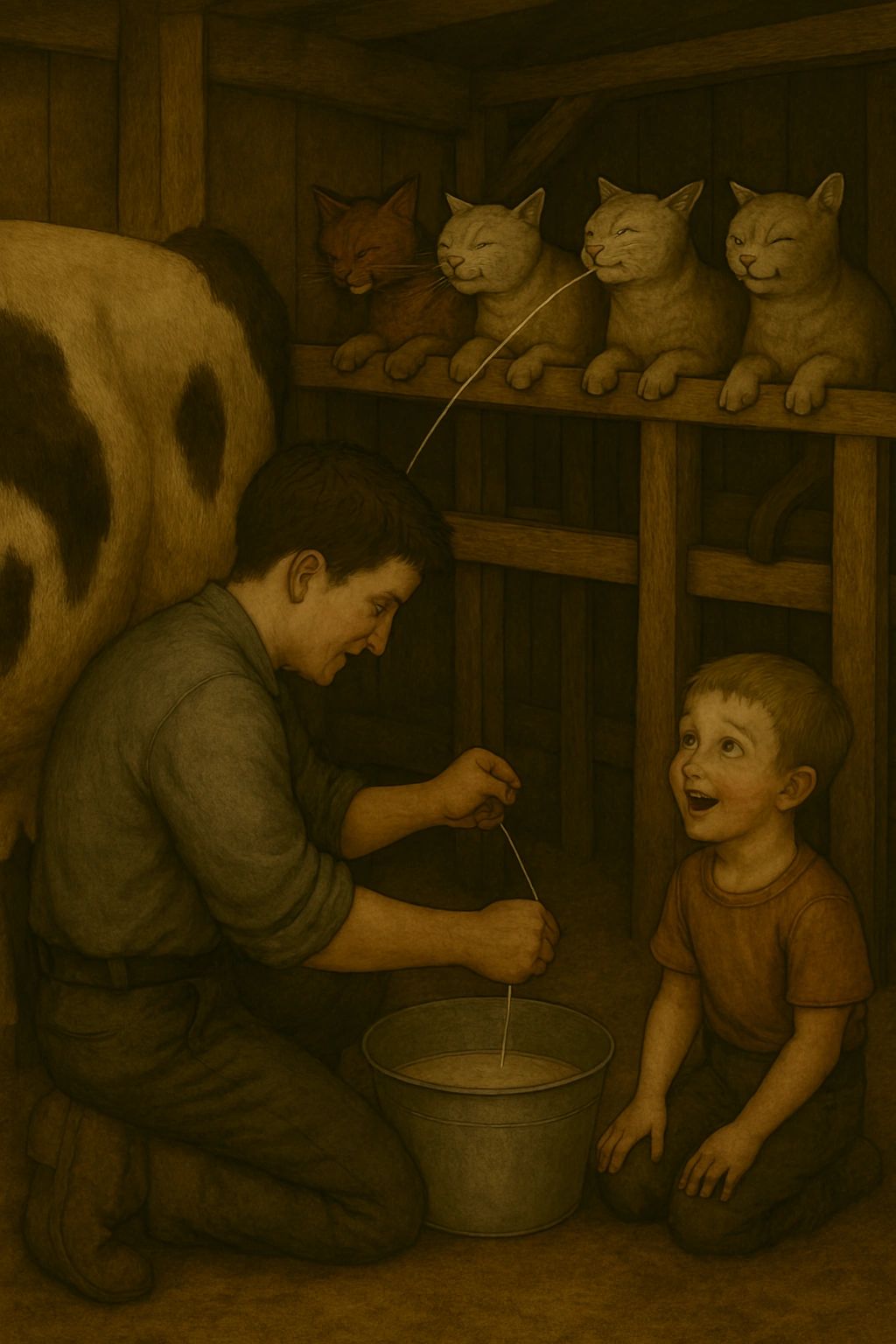
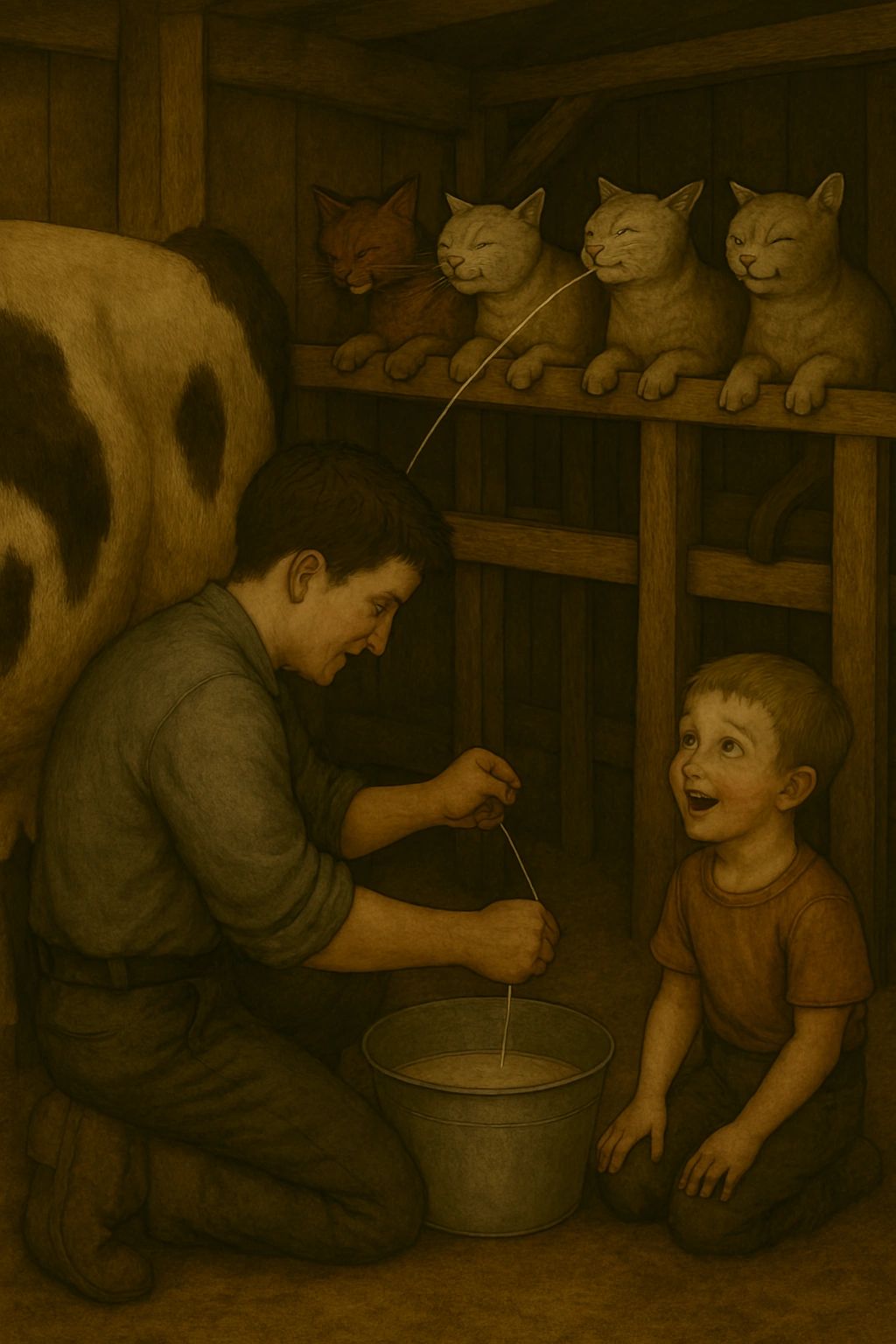
    I shook my head. The cows were so big up close, and their breath steamed out in long snooty huffs. Instead, I watched as he kneaded the udder and winked at me, “She likes it, see? You gotta be gentle but mean it.” And then the strangest thing in the world: before the first arc of milk splattered into the pail, Dale pinched his fingers, aimed at the nearest cat, and squirted a perfect white stream right over my head.

    Possum leapt up, thin as a rope, paws against the stall board, and lapped the droplets out of the air, then yowled for more. The other cats caught on fast, climbing the rails, mewing, waiting their turn. Uncle Dale kept at it, every so often tilting the udder just so for a direct hit, like he’d spent a whole alternate childhood learning to bullseye cats with cow milk.

    Afterwards, the cats hung around, licking their chops and purring so loud the barn seemed to hum. The cows settled back into a slow rhythm of chewing, and Uncle Dale wiped his hands, chucked a handful of hay at my head, and we trudged back toward the kitchen, Possum and his crew already melting into the weeds.

    Grandmamma would have breakfast waiting on us when we got back. Breakfast was eggs and grits and bacon and biscuits and more eggs, and Granddady’s coffee, black as burnt wood, which I wasn’t allowed to drink but Uncle Dale poured into his cup and had with his grits anyway, as if the whole bucket of milk had been a warm-up act for coffee and grits.

    “You catch them cats eating from the spout again?” Granddaddy asked, half turning from the stove.

    Uncle Dale shrugged, smiled at me, and said, “Can’t stop ‘em. Little jerks are all over the place.”

    Granddaddy shook his head like he’d heard this story every morning since time began. “Supposed to keep cats outside.”

    “They ain’t hurting nothin’,” Uncle Dale said, pouring a third helping and sliding it my way.

    For three more mornings, the whole thing repeated: up before the sun, milk the cows, feed the cats, watch the world light up slow and gold, all of us standing inside the barn like weird saints with buckets and brooms. The last day, Uncle Dale let me shoot the milk for Possum. It took three messy tries, but the fourth time, the stream arced high and Possum nailed it, smacking his jaws together like he’d eaten a ghost. My hands shook from the squeeze, but Uncle Dale just laughed and said, “Good aim for a Yankees fan.”

    At the end of the week, I stood on the porch with my bag, listening to the barn cats fighting in the grass and the cows lowing for breakfast, and I tried to imagine what Monday would feel like without the part where you woke up in a house that smelled like hay, and went to sleep every night with the sound of fields brushing each other silent and slow. Next school year I would be too big for any of this and it sorta made me excited and sad all at the same time, as if an important part of my life would be over and would never come back.

    After my ride with my parents pulled away, I looked back once and thought I saw Possum watching from the barn roof, tail flicking, as if he was waiting for someone to bring him a little more milk.

  • Grandy and Jones’s Barber Shop

    The thing about Grandy and Jones’s Barber Shop was the way the air changed the minute I walked in. It always hit me first in the nose: a sharpness of witch hazel and talcum, sweetened by pipe smoke, and then the tang of steel when the old men scraped their razors on the leather strop. You could tell it was a man’s place by how every surface was nicked and burnished and a little sticky with history—right down to the checkerboard linoleum, which looked like someone had spilled a hundred years of stories on it and tried to mop them up with spit and a dirty rag.

    I was eight years old, which was too young for some things but not for the world of Grandy and Jones. I’d started coming with Daddy on Saturdays, trailing him like a barncat on a milk run, just to sit and listen. The barbers, Mr. Grandy and Mr. Jones, ran the shop together but argued about everything from baseball teams to the best way to sharpen a razor. Mr. Grandy was slim and neat in his white smock and always drank his Pepsi from a green glass bottle. Mr. Jones was all belly and jowls and a voice that could scare a possum out of a tree, but he had the gentlest hands when it came to corraling a cowlick. It was Mr. Jones who’d first announced that I needed a shave.

    He pulled me up into the big red chair, tossing a sheet over me like he was tucking in a baby, then worked his palm over my cheeks with a showman’s gravity.

    “Well, Lordamercy,” he said, “this young man’s sprouting a pelt finer than his daddy’s already.”

    The men in the waiting chairs snorted and coughed up their approval. I blinked. My face still felt like a peeled grape, but I didn’t argue. When Mr. Jones painted on the Barbasol with a badger-hair brush, the lather was cold and smelled clean and grown-up. It was the closest I’d ever been to a manhood ceremony.

    Mr. Jones flicked the straight razor open with a wrist snap and looked me in the eye. “You sit still or I’ll have your mother on my hide for nicks.”

    I sat like a stone. He scraped the blade over my jaw, gentle as a whisper, and every time he rinsed it in the blue glass cup, I watched the white foam swirl away like a cloud breaking up in a storm.

    “There,” he said after a minute. “Good as new. Tell your mama Grandy and Jones will have you whisker-free till high school.”

    The stories in the waiting area got louder after that. Saturdays were showtime: old men from up and down Main Street came to air out their politics and their aches, to gossip about the mayor or tell about the catfish they’d caught in the millpond. There was always at least one story about Mr. Wilburn, the town’s only Yankee, who’d once gotten so mad at the fire chief that he’d shot his own mailbox. When it was just me and Daddy, I liked to believe that I was invisible, that I could soak up every word without anyone noticing, but Mr. Grandy would wink at me in the mirror and say, “Don’t listen to these rascals, son. They’ll fill your head with foolishness, and you’ll never get it out.”

    I listened anyway. I learned about the time Lightning struck the Methodist steeple and the roof caught fire, and how the preacher’s wife ran up there in her nightgown and doused the blaze with a bucket of rainwater. I learned which teachers at the school were mean as snakes and which ones let you sleep after lunch. When the Vietnam letters started coming back, the stories got quieter and the men’s faces changed, but the shop never stopped smelling like pipe smoke and aftershave.

    One time, after Daddy’s haircut, Mr. Grandy called me over. “You ever think about being a barber?” he said, spinning the chair so I could see myself in the mirror. “It’s a good trade. You get to hear the whole world, two bucks at a time.”

    I stared at my reflection, my face still slick with aftershave, and for a second, I tried to imagine myself grown up, giving shaves and telling stories. I couldn’t picture it, not really, but I wanted to keep coming, to keep listening. I wanted to remember every word of every Saturday, the way the men’s voices mixed with the snick-snack of scissors, the glint of sunlight on the Pepsi bottle, the smell of my own skin, cold and clean and new.

    ***I still remember the Saturdays and the stories and the smells…

  • Crabapple Creek Radio

    Starting this week, check out the Crabapple Creek Radio Podcast! These will be vintage radio shows from yester-year. As a general rule, it will include Mystery Monday (CBS Mystery Theater Shows), Tarzan Tuesdays (Tarzan Radio Broadcasts), Wild West Wednesday (The Lone Ranger), Throwback Thursdays, where we will throw out the (Dragnet), Fun Fridays, where we visit (Mel Blanc’s Fix-it Shop), Sci-Fi Saturday (Science Fiction stories), and Super Sundays (Superman). We will also throw in various other vintage radio shows along the way. Why? Because these broadcasts were full of stories! If you have any other broadcasts you’d like to see (hear), just let me know and I will try to locate them. Enjoy!

  • Morning Routine in Leesville…

    I was five and it would be the last time during the school year that I would be able to spend a week with my grandparents. My Daddy’s younger brother, Uncle Dale, still lived at home with my grandparents.

    Every morning at my grandparents’ began exactly the same: with the rusty clock alarm in the den shrieking at 5:15, then two snooze buttons later, the long creak of Granddaddy’s knees as he swung his feet over the edge of the bed and called down the hallway, “Dale! Up! Milk’s a-waitin’!” and Uncle Dale—who was seventeen, a high school senior, and owned more traffic tickets than pairs of clean jeans—would groan loud as a dying steer before thumping out his door, backwards ballcap already mashed to his head.

    I’d been there three days and still couldn’t figure out if Dale was sleepwalking for these barn trips or just practicing for a future as a zombie. But every morning, just as the sun shook off the last gray, he’d gesture at me, wordless, and I’d hop off my fold-out cot and into my dirty overalls and run behind him, down the porch steps into the dew, the air cold enough to bite but already smelling faintly of manure and cow breath.

    Outside, the world was so empty it rang. Just fields, the barn, the shade trees that still dripped rain from the night, and the sad, one-eyed barn cat Granddaddy called “Possum,” even though “she” was a “he,” and had maybe never caught a mouse his whole life. Except the second Dale kicked open the barn’s side door, Possum perked up and limped after us, then came a half dozen more feral cats, all mangy and wild-eyed, as if the sound of stanchions clanking was dinner bell and church at once.

    The barn was old, but not in a storybook way—with its tin roof dented inward like a kicked can, and the paint gone so long you could see every plank and nail. Inside, the air was cleaner, warmer, full of dust motes and the living thud of the cows shifting in their stalls. They had names, all of them—Bessie and Boo and Agnes and Gertrude—but Dale called them all “girl” in the same tone he used with his steady, Cheryl, when they argued on the party-line phone.

    He heaved the bucket and stool into the nearest stall, patted the cow’s hip, and when he sat down, his body seemed to melt into a different shape, one that fit the barn and the cow and the coming morning. “You wanna try?” Dale said, jerking his chin.

    I shook my head. The cows were so big up close, and their breath steamed out in long snooty huffs. Instead, I watched as he kneaded the udder and winked at me, “She likes it, see? You gotta be gentle but mean it.” And then the strangest thing in the world: before the first arc of milk splattered into the pail, Dale pinched his fingers, aimed at the nearest cat, and squirted a perfect white stream right over my head.

    Possum leapt up, thin as a rope, paws against the stall board, and lapped the droplets out of the air, then yowled for more. The other cats caught on fast, climbing the rails, mewing, waiting their turn. Uncle Dale kept at it, every so often tilting the udder just so for a direct hit, like he’d spent a whole alternate childhood learning to bullseye cats with cow milk.

    Afterwards, the cats hung around, licking their chops and purring so loud the barn seemed to hum. The cows settled back into a slow rhythm of chewing, and Uncle Dale wiped his hands, chucked a handful of hay at my head, and we trudged back toward the kitchen, Possum and his crew already melting into the weeds.

    Grandmamma would have breakfast waiting on us when we got back. Breakfast was eggs and grits and bacon and biscuits and more eggs, and Granddady’s coffee, black as burnt wood, which I wasn’t allowed to drink but Uncle Dale poured into his cup and had with his grits anyway, as if the whole bucket of milk had been a warm-up act for coffee and grits.

    “You catch them cats eating from the spout again?” Granddaddy asked, half turning from the stove.

    Uncle Dale shrugged, smiled at me, and said, “Can’t stop ‘em. Little jerks are all over the place.”

    Granddaddy shook his head like he’d heard this story every morning since time began. “Supposed to keep cats outside.”

    “They ain’t hurting nothin’,” Uncle Dale said, pouring a third helping and sliding it my way.

    For three more mornings, the whole thing repeated: up before the sun, milk the cows, feed the cats, watch the world light up slow and gold, all of us standing inside the barn like weird saints with buckets and brooms. The last day, Uncle Dale let me shoot the milk for Possum. It took three messy tries, but the fourth time, the stream arced high and Possum nailed it, smacking his jaws together like he’d eaten a ghost. My hands shook from the squeeze, but Uncle Dale just laughed and said, “Good aim for a Yankees fan.”

    At the end of the week, I stood on the porch with my bag, listening to the barn cats fighting in the grass and the cows lowing for breakfast, and I tried to imagine what Monday would feel like without the part where you woke up in a house that smelled like hay, and went to sleep every night with the sound of fields brushing each other silent and slow. Next school year I would be too big for any of this and it sorta made me excited and sad all at the same time, as if an important part of my life would be over and would never come back.

    After my ride with my parents pulled away, I looked back once and thought I saw Possum watching from the barn roof, tail flicking, as if he was waiting for someone to bring him a little more milk.

  • Contemplating the Leaf…

    Drifting down from a tree so tall

    A leaf, once green, now in its golden fall

    Fragile and delicate, it fell from grace

    But did it have a life to trace?

    Did it ever ponder its existence?

    Or was it content to just be a presence

    On a tree that swayed in the breeze

    And whispered secrets to the leaves?

    Did it ever dream of flying free

    Or was it content to just be a part of the tree?

    Did it fear the unknown below

    As it let go and started to slow?

    Did it remember the days of spring

    When it was new and everything?

    Or did it only live in the present

    Without a thought for what was pleasant?

    As it drifted down to the ground

    Did it hear the rustling sound

    Of other leaves joining in its fate

    Or did it accept its lonely state?

    Did it feel the weight of its short life

    As it lay on the earth, no longer rife

    With the energy of growth and change

    Or was it content to simply rearrange?

    I watched the leaf fall from the tree

    And wondered if it ever felt free

    But as I saw it crumble and decay

    I knew it had lived its life in its own way.

    D.B.